Providing Quality Continuing Education for Radiologic Professionals since 1991

Special Pricing!  -  $59.50 for 24 CE's  -  Human Radiation Experiments - Part 1 or Part 2 eBook and Test

RSS

Blog posts of '2025' 'December'

A Banana Through the Scanner: One Object, Three Imaging Modalities

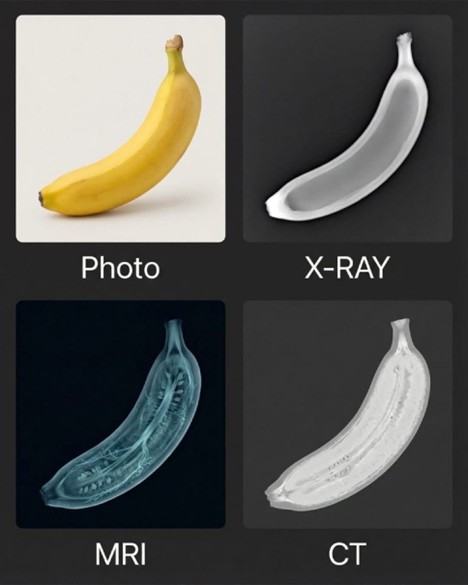
At first glance, a banana seems like an unlikely teaching tool for medical imaging—but that’s exactly what makes it effective. The image above shows a banana captured using standard photography alongside X-ray, CT, and MRI, offering a simple, intuitive comparison of how each modality “sees” the same object.

Plain Photo: What the Eye Sees
The photograph represents our baseline: surface color, shape, and texture. While useful for orientation, it tells us nothing about internal structure—precisely where medical imaging adds value.

X-ray: Density in Its Simplest Form
In the X-ray image, the banana appears mostly uniform with subtle variations. X-ray imaging is driven by differences in attenuation, so soft tissues with similar densities tend to blend together. This mirrors clinical reality: X-ray excels at detecting high-contrast structures (like bone or metal), but offers limited soft-tissue detail.

CT: Cross-Sectional Density Mapping
The CT image adds clarity by reconstructing attenuation data into cross-sectional detail. Here, the banana’s peel and inner pulp become distinguishable due to small density differences. This highlights CT’s strength in resolving subtle contrast while maintaining excellent spatial resolution—one reason it’s so widely used for rapid, whole-body assessment.

MRI: Signal, Not Density
The MRI view looks dramatically different. Instead of density, MRI reflects differences in tissue properties such as proton density and relaxation times. The internal fibrous structure of the banana becomes visible, illustrating why MRI is so powerful for soft-tissue characterization—and why its images often look unfamiliar to those trained primarily on X-ray or CT.

Why This Matters for Imaging Professionals
Using a familiar object removes anatomy from the equation and puts the focus squarely on physics and modality strengths. For continuing education, examples like this reinforce a core principle of medical imaging: each modality answers different clinical questions. Mastery comes from understanding not just how to acquire images, but how and why they look the way they do.

Sometimes, the best way to sharpen our diagnostic perspective is to look at something completely ordinary—through an extraordinary lens. 🍌

How AI Will Change the Role of Radiologic Technologists: A 2025–2035 Outlook

Introduction

Artificial intelligence is no longer something we talk about in vague, futuristic terms at conferences or vendor booths. It is already embedded in scanners, PACS, and workflow tools across imaging departments — and its influence will only grow stronger over the next decade.

For radiologic technologists, this can trigger mixed emotions. Some see AI as exciting and empowering. Others worry about job security, deskilling, or being “replaced by machines.” The reality sits somewhere in between — and it’s far more positive than many headlines suggest.

AI is not here to replace technologists. It is here to reshape the role into something more skilled, more analytical, and more patient-centered than ever before. Just as digital imaging didn’t eliminate technologists (but changed how they worked), AI is the next major evolution in the profession.

This article walks through exactly how AI will change daily workflow, responsibilities, education requirements, and career opportunities for radiologic technologists between 2025 and 2035. No buzzwords. No fear-mongering. Just a practical look at what’s coming — and how to be ready for it.


1. The 5 Core Areas Where AI Is Transforming Imaging

AI in medical imaging isn’t one single thing. It shows up in multiple parts of the imaging chain, from the moment a patient walks into the room to the moment the study is read and archived. For technologists, five areas matter the most.

1.1 Image Acquisition

Image acquisition is where technologists spend most of their time — and it’s also where AI is making some of the biggest immediate changes.

Modern scanners increasingly use AI to assist with:

Correcting patient positioning
AI-powered cameras and sensors can detect patient alignment errors before the scan starts. In CT and X-ray, systems can alert you if the patient is off-center, rotated, or not aligned with the isocenter. Instead of relying only on visual estimation, technologists get objective feedback in real time.

Auto-selecting protocols
Based on patient size, age, indication, and prior exams, AI can suggest the most appropriate protocol. This doesn’t remove technologist decision-making — it reduces guesswork and helps standardize exams across staff and shifts.

Predicting exposure parameters
AI can estimate optimal kVp, mA, and timing based on patient anatomy and positioning. This helps reduce dose variability between technologists while maintaining image quality.

Reducing motion artifacts
Some systems now detect patient motion during the scan and automatically adjust acquisition parameters or recommend repeat scans only when necessary. This is especially valuable in pediatrics, trauma, and patients who struggle to hold still.

Improving ultrasound acquisition
AI-assisted ultrasound is one of the fastest-growing areas. Real-time guidance can help technologists find optimal windows, maintain correct probe orientation, and ensure required anatomy is captured — especially useful for less experienced users or challenging patients.

What this means for technologists:
You’ll spend less time fighting the scanner and more time making informed decisions. Positioning still matters — but now you have intelligent feedback instead of trial-and-error.


1.2 Image Reconstruction

Image reconstruction used to be largely invisible to technologists. You pressed “reconstruct,” waited, and accepted what the system produced. AI changes that completely.

AI-based reconstruction algorithms now:

Lower CT dose
By using deep learning to reduce noise, scanners can produce diagnostic images at significantly lower radiation doses. This shifts dose management from being a static protocol issue to an adaptive, patient-specific process.

Reduce MRI scan time
AI reconstruction allows under-sampled MRI data to be reconstructed into high-quality images. Shorter scan times mean fewer motion artifacts, higher patient throughput, and better patient experience.

Improve SNR and CNR
Signal-to-noise ratio and contrast-to-noise ratio improve without increasing dose or scan time. That’s a major win for image quality.

Enhance image sharpness
Edges are cleaner, anatomy is clearer, and subtle findings are easier to visualize — which helps radiologists but also helps technologists verify image adequacy before sending studies.

Reduce dependence on high-end hardware
AI reconstruction can make mid-range systems perform closer to premium systems, which has implications for smaller facilities and outpatient centers.

What this means for technologists:
Understanding reconstruction choices will matter. Techs won’t just select “standard” or “soft tissue” anymore — they’ll need to understand how AI reconstruction affects appearance, artifacts, and diagnostic confidence.


1.3 Workflow Automation

Workflow is where technologists feel burnout the most — and where AI can make daily life noticeably better.

AI-powered workflow tools can:

Sort studies by urgency
Based on indication, clinical data, and imaging findings, AI can prioritize trauma, stroke, or critical cases automatically.

Flag critical results
Some systems identify findings like intracranial hemorrhage or pneumothorax and alert radiologists faster — shortening time to treatment.

Prepopulate exam notes
Instead of manually typing repetitive documentation, AI can auto-fill portions of exam notes based on protocol, scanner data, and observed events.

Identify missing sequences
In MRI especially, AI can detect if required sequences were skipped or improperly acquired before the patient leaves the scanner.

Recommend protocol adjustments
If a study isn’t answering the clinical question, AI can suggest additional views or sequences in real time.

What this means for technologists:
Less mental load. Fewer callbacks. Fewer “why wasn’t this done?” moments. The technologist’s role shifts from manual coordination to intelligent oversight.


1.4 Quality Assurance

Consistency has always been a challenge in imaging. Two technologists can perform the same exam very differently. AI helps narrow that gap.

AI-based quality assurance tools detect:

Positioning errors
Off-center anatomy, poor collimation, and rotation can be flagged automatically.

Missing anatomy
If required anatomy isn’t fully included, the system can alert the technologist before the patient leaves.

Motion artifacts
AI can differentiate between acceptable and non-diagnostic motion — reducing unnecessary repeats.

Incorrect slice thickness
Especially in CT and MRI, slice thickness errors can be identified immediately.

Under- or overexposure
Exposure inconsistencies can be tracked and corrected over time.

What this means for technologists:
Quality becomes measurable, objective, and consistent — not dependent on who is working that day. This supports technologists instead of policing them.


1.5 Patient Safety

Patient safety may be the most important — and most underestimated — contribution of AI.

AI supports:

Dose optimization
By analyzing thousands of prior exams, AI can recommend dose levels tailored to patient size, anatomy, and indication.

MRI implant safety verification
AI can cross-reference implant databases, scanner parameters, and patient records to reduce MRI safety risks.

Contrast reaction prediction
By analyzing patient history, lab values, and prior reactions, AI can flag patients at higher risk before contrast administration.

Real-time monitoring
Some systems monitor patient vitals, movement, and distress signals during scans — especially helpful in MRI and CT.

What this means for technologists:
You remain the safety gatekeeper — but now with better tools and better data backing your decisions.


2. Will AI Replace Technologists?

Short answer: No.

Long answer: AI removes tasks, not responsibility.

Here’s why technologists aren’t going anywhere:

Imaging requires human judgment
AI can suggest, but it can’t fully understand context — especially in complex or unexpected situations.

Anatomy varies widely
Real patients don’t look like training datasets. Body habitus, pathology, and surgical changes require human interpretation during acquisition.

Patient conditions differ
Pain, anxiety, confusion, trauma — these require empathy, communication, and adaptability.

Emergency care needs human flexibility
AI struggles in chaotic, fast-changing environments where protocols must be adjusted on the fly.

Safety oversight cannot be automated
Technologists make judgment calls every day that involve risk assessment and ethical responsibility.

Communication is irreplaceable
Explaining exams, calming patients, coordinating with nurses and physicians — these are human skills.

AI doesn’t eliminate technologists. It removes repetitive tasks and amplifies human ability.


3. The New Skillset Technologists Will Need

As AI handles more routine work, technologists will be expected to bring higher-level skills to the table.

Key competencies will include:

AI literacy
Not programming — but understanding what AI does, where it fails, and how to use it responsibly.

Protocol management
Techs will increasingly customize and refine protocols instead of simply selecting presets.

Reconstruction science
Knowing how AI reconstruction affects image appearance and diagnostic value.

Anatomy interpretation
Not diagnosing — but recognizing whether anatomy and pathology are adequately captured.

Quality assurance auditing
Using AI feedback to improve consistency and performance.

Informatics & data literacy
Understanding how imaging data flows through PACS, RIS, and AI systems.

Advanced patient assessment
Evaluating patient condition, risk, and needs beyond basic screening questions.

These skills increase career value, autonomy, and professional respect.


4. New Career Paths Emerging Because of AI

AI isn’t shrinking the profession — it’s expanding it.

4.1 Imaging AI Workflow Specialist

These technologists support AI algorithm performance, integration, and quality control. They act as the bridge between clinical staff, IT, and vendors.

4.2 Protocol Optimization Technologist

Focused on refining CT and MRI protocols using AI-supported tools to balance dose, image quality, and efficiency.

4.3 Dose-Safety Technologist

Uses AI analytics to monitor radiation exposure trends, standardize practice, and support regulatory compliance.

4.4 AI Trainer / Clinical Educator

Educates staff on how to use AI-enhanced imaging systems safely and effectively.

These roles didn’t exist a decade ago — and more will appear as AI matures.


5. How Technologists Can Prepare for the AI Era

You don’t need to become a data scientist. But you do need to stay engaged.

Recommended continuing education topics include:

  • AI in medical imaging
  • CT and MRI protocol optimization
  • Dose-reduction techniques
  • Advanced anatomy
  • MRI safety
  • Informatics fundamentals

The technologists who thrive between 2025 and 2035 will be the ones who lean into change instead of resisting it.


Final Thoughts

AI is not the end of radiologic technology — it’s the next evolution of it.

The profession is moving toward greater expertise, greater responsibility, and greater influence on patient care. Technologists will be less like button-pushers and more like imaging specialists.

The future belongs to those who adapt, learn, and lead.

And that future is already here.
 

Pediatric Imaging Essentials: The 2026 Guide Every Rad Tech Actually Needs

Hey there, fellow rad tech! If you’ve ever tried to get a perfect PA chest on a screaming two-year-old at 2 a.m., you already know: kids are not just tiny adults. Pediatric imaging can feel like the ultimate test of your skills, patience, and creativity — all at the same time.

I’ve been in the trenches for years, and I still learn something new on almost every peds shift. So I put together this super-practical, no-fluff guide (updated for 2025) to help you nail pediatric X-ray, CT, MRI, and ultrasound while keeping radiation dose tiny and anxiety even tinier.

Let’s dive in — grab your coffee and let’s make you a pediatric imaging rockstar.

Why Kids Make Us Sweat (and Why You Need Special Skills)

Kids are basically aliens in tiny sneakers. Here’s why you can’t just shrink your adult protocols:

  • Their heads are huge compared to their bodies (hello, giant thymus on every chest X-ray).
  • Their cells are dividing like crazy → way more sensitive to radiation.
  • They have zero chill when it comes to holding still.
  • Most of them think the X-ray tube is a monster that eats kids.

Bottom line? You have to adjust your technique, your positioning, and your entire vibe when a child rolls into your department.

Radiation Safety: ALARA Isn’t Optional with Kids

We all know ALARA (As Low As Reasonably Achievable), but with pediatric patients it’s basically the 11th commandment.

Here’s what actually moves the needle in 2025:

  • Drop that mAs like it’s hot and bump kVp a little if contrast allows.
  • Collimate like your license depends on it (because it kind of does.
  • Take the grid OUT for anyone under ~10–12 cm thick (most babies and toddlers). You’ll cut dose in half with almost zero image quality loss on modern DR plates.
  • Use PA chest and spine whenever the kid can tolerate it — breast and thyroid dose drops 80–90%.
  • Shielding update: most new guidelines say skip routine gonadal shields if you’re collimating correctly (they cause more repeats than protection these days).

Biggest sins I still see in 2025?

  • Using the exact same adult exposure chart
  • Leaving the grid in for a 5 kg baby
  • Doing every chest AP “because it’s faster”
  • Repeating exams because of motion instead of fixing the motion first

How to Talk to Kids So They Actually Listen (and Stay Still)

Forget “big stick energy.” With kids, you need “Disney cast member + ninja” energy.

Quick age-by-age cheat sheet:

Babies (0–6 months) Swaddle, warm room (78–82 °F), feed right before the exam, and pray to the sleep gods. Works like magic for MRI and ultrasound too.

Toddlers (1–3 years) Slow voice, bubbles, ceiling projectors, tablets, or a parent doing the “mommy hug” hold. Never underestimate the power of singing “Baby Shark” in perfect pitch.

Preschool & school-age (4–10) Give them control: “Do you want to push the button or should I?” Show them a demo picture. Kids love being the expert: “You’re going to be my helper superhero.”

Teens Talk to them like humans. Explain the “why” (radiation risk, how long the scan takes, etc.). Respect privacy. Knock. Don’t call them “sweetie.”

Pro parent hack: Give mom or dad a job (“Your only mission is to hold this exact spot — you’ve got this”). Parents love having a purpose, and it keeps them from hovering.

Positioning Hacks That Save Your Back (and Their Dose)

X-ray Quick Wins

  • Pigg-O-Stat is awesome… until the kid loses it. Always have a Plan B (parent hug or supine with sandbags).
  • Chest on infants? Expose on second breath, not full inspiration (thymus looks better).
  • Always include the diaphragm on upright abdomens — doctors hate cropped gas patterns.
  • Extremity trauma? Image both sides. Peds docs live for symmetry.

CT Like a Pro

  • Single phase only unless the radiologist begs.
  • 70–80 kVp + iterative/AI reconstruction = gorgeous images at half the dose.
  • Most kids over 6 months can do a head or chest CT awake if you have a child-life specialist or a good distraction system.

MRI Survival Guide

  • Under 6 months → feed-and-sleep + ear plugs + vacuum pillow = 90% success rate.
  • 4 years and up → MRI video goggles are literal lifesavers.
  • Use Propeller/BLADE sequences for the wiggle worms.

Ultrasound Love

  • Warm gel. Seriously. Cold gel = instant screaming.
  • High-frequency linear probe for everything superficial.
  • Let the kid watch the screen — “Look, that’s your baby brother/sister’s heartbeat!” works on siblings too.

The Really Tough Days (Trauma, Autism, Oncology, Abuse Cases)

  • Trauma: ABCs first, perfect images second. Log-roll, portable, parent present when safe.
  • Autism/sensory issues: Visual schedules, noise-canceling headphones, dim lights, practice run on a fake machine if possible.
  • Oncology kids: Track cumulative dose like a hawk. Push for US or MRI first.
  • Suspected non-accidental trauma: Follow your hospital’s exact skeletal survey protocol. Stay neutral, document everything, report properly.

Keep Getting Better (Because Guidelines Change Every Year)

The tech, the dose recommendations, the immobilization gadgets — everything evolves fast.

If you want structured, ASRT-approved credits that actually teach useful stuff, check out Gage CE’s 2025 pediatric lineup. Real talk: their “Zero-Sedation MRI” course and the 8-hour radiation protection masterclass changed how I practice.

Final Thought From One Tech to Another

At the end of a crazy shift, when you finally get that perfect chest X-ray on a terrified three-year-old who’s now waving goodbye and saying “thank you,” that feeling? That’s why we do this.

You’re not just taking pictures. You’re protecting tiny humans, calming scared parents, and giving doctors the answers they need — all while juggling bubbles, swaddles, and a lead apron that never fits right.

Keep lowering those doses. Keep practicing your toddler voice. Keep learning.

You’ve got this.


How to Avoid Burnout as an Imaging Technologist: A Practical and Evidence-Based Guide

You already know the feeling. You walk out of the department after a 12-hour shift, legs throbbing, neck stiff, and somehow still carrying the weight of the last trauma patient whose family was screaming in the hallway. You tell yourself you’re fine—“this is just healthcare”—but the dread of tomorrow’s alarm clock is already creeping in.

You’re not weak. You’re not “just stressed.” You’re experiencing an occupational hazard that the data now ranks among the highest in all of healthcare: burnout in radiologic technology.

A 2023 study in Radiologic Technology found that 64% of imaging technologists met criteria for high emotional exhaustion, surpassing many nursing specialties. A 2024 follow-up in JACR tied that exhaustion directly to staffing ratios, exam volume increases of 28% since 2019, and the emotional load of oncology and emergency imaging. Left unchecked, burnout becomes depression, turnover, medication errors, and patient-safety events nobody wants on their conscience.

This guide isn’t about bubble baths or “drink more water.” It’s about the exact, evidence-based tactics that practicing techs, lead techs, and department managers have used—in real Level I trauma centers and busy outpatient imaging centers—to stay in the profession they once loved without destroying themselves.

Let’s get to work.

1. What Burnout Actually Looks Like in Radiology

Burnout shows up differently here than it does on the floor or in the OR.

You’re not crying in the break room (usually). Instead you notice:

  • Mental exhaustion that coffee no longer touches
  • Emotional detachment—“Whatever, another stroke”—followed by guilt for feeling that way
  • Irritability that leaks out on coworkers who don’t deserve it
  • Difficulty concentrating on protocols you’ve done ten thousand times
  • A creeping increase in minor errors (wrong laterality marker, forgetting to remove a bra, double-dosing oral contrast)
  • Feeling chronically underappreciated despite being told “you guys are the backbone of the department”
  • Dreading your alarm three hours before it goes off
  • Fantasizing about any job that lets you sit down

If you recognize four or more of those bullets, you’re already on the burnout curve. The goal is to reverse it before it becomes a resignation letter.

2. Why Imaging Technologists Are Uniquely Vulnerable

Burnout is not a character flaw. It is the predictable outcome of chronic workplace stressors without adequate recovery. In imaging those stressors are baked into the job:

  • Chronic understaffing: The average department is running 1–3 techs short every shift (ASRT 2024 staffing survey).
  • Trauma and ED environments: Constant exposure to death and critical injury without the psychological closure nurses or physicians get.
  • Repetitive motion strain: More than 70% of techs report chronic pain by year ten (NIOSH 2023).
  • Exam volumes up 25–40% since 2019 while staffing has not kept pace.
  • 10- and 12-hour shifts almost entirely on your feet with legally mandated but practically nonexistent breaks.
  • High-stakes patient interactions: Combative intoxicated patients, devastated families, language barriers, pediatric cases where you’re holding a screaming child alone.
  • Dual pressure of speed (“Can you take the add-on stat?”) and perfection (“One wrong marker and we’re sued”).

The combination creates what researchers call “effort-reward imbalance”—you give maximum effort and receive minimal recovery or recognition in return. That imbalance is the single best predictor of burnout across professions.

3. Evidence-Based Strategies You Can Start Tomorrow

3.1 Take Back Control of Your Workflow (Even When the Department Won’t)

A 2022 study in Radiology Management showed that perceived control over one’s immediate work environment is the strongest mitigator of emotional exhaustion in imaging—stronger than pay or years of experience.

You rarely control staffing, but you can control your 10-foot radius.

Practical moves that take <5 minutes of prep but save hours of frustration:

  • Pre-shift bay reset: Wipe surfaces, restock blankets, oral contrast, gloves, and needle bins the night before or first thing in the morning. Walking into chaos spikes cortisol before the first patient.
  • Standardize your personal sequence: Same order every time—position patient → markers → collimation → exposure → shields. Muscle memory reduces decision fatigue.
  • “Home-base” stocking: Keep your most-used items (tape, markers, chucks, 18g needles) in the exact same pocket or drawer location across rooms.
  • Advocate for one protocol change per quarter: A single improvement (e.g., pre-filled water cups for CT oral prep, standardized trauma spine series) compounds across the department and gives you a win.

Techs who report “high workflow control” score 42% lower on the Maslach Burnout Inventory.

3.2 Master the Micro-Break (15–30 seconds)

Full breaks are a fantasy on most shifts. Micro-breaks are not.

A 2024 randomized trial in Journal of Applied Ergonomics had fluoroscopy techs perform 20-second interventions every 20–30 minutes. Neck pain dropped 38%, perceived fatigue dropped 31%, and cortisol measured via saliva decreased significantly.

Four micro-breaks that actually work in lead:

  1. Shoulder rolls + trapezius stretch (20 sec)
  2. 4-7-8 breathing (box breathing works too) – inhale 4, hold 7, exhale 8
  3. Palming for eye strain: Rub hands together, cup over closed eyes, 10–15 sec
  4. Finger/wrist flicks and prayer stretch against the wall

Set a silent timer on your watch or phone for every 25 minutes. No one will notice, and you’ll arrive home able to turn your head.

3.3 Build a Mental “Decompression Ritual” for Emotional Load

You don’t get the closure of seeing a patient recover. You often only see them at their worst.

Techs who practice deliberate compartmentalization have lower secondary traumatic stress scores (2023 study, Radiography).

Effective rituals used by veteran trauma techs:

  • The Door Close: Literally visualize closing a door on the case as you walk out of the gantry. One tech imagines locking it and swallowing the key.
  • 90-second rule: Allow yourself exactly 90 seconds in the restroom or stairwell to feel whatever came up—then move on.
  • Debrief trigger phrase: “Rough one?” with a trusted coworker is enough to offload without spiraling.
  • End-of-shift download: 2-minute voice memo on your drive home summarizing the hardest case so it doesn’t follow you through the front door.

You’re not cold for doing this. You’re protecting your ability to care tomorrow.

3.4 Make Peer Support Non-Negotiable

The single strongest protective factor against burnout in imaging is perceived coworker support (2024 meta-analysis, 19 studies, n=8,400 techs).

Concrete actions that cost nothing:

  • “Check-in” script during crazy shifts: “You good?” takes two seconds and means everything.
  • Relief rule: If someone is stuck in a 45-minute fluoro case with no break, the next free tech automatically offers 5 minutes of relief.
  • “Win board” in the break room: Sticky notes of small victories (“Nailed a 400-lb lateral hip without help,” “Got a 2-year-old to hold still for chest”).
  • Lead tech open-door hours: 15 minutes every Friday where anyone can walk in with concerns, no agenda required.

Departments that score in the top quartile of peer support have 68% lower turnover.

3.5 Protect Your Body Like It’s Your License (Because It Is)

Seventy-two percent of techs over age 40 report chronic musculoskeletal pain. Pain is a burnout accelerant.

Non-negotiable ergonomics:

  • Never bend at the waist holding a cassette or image receptor—drop into a squat.
  • Use the patient movers that administration “doesn’t have budget for”—they do, you just have to write the incident report when you throw your back out.
  • When positioning heavy body parts (arms for chest X-rays, legs for portables), move your feet instead of twisting your spine.
  • Table height rule: Elbows at 90° when you’re working. Adjust the table, not your posture.
  • Anti-fatigue mats in every room—fight for them. They reduce perceived exertion by 22% over an 8-hour shift.

Your body is the tool you can’t replace.

4. Long-Term Career Strategies to Stay in Love With the Profession

Sometimes daily tactics aren’t enough. You need a bigger lever.

4.1 Cross-Train Into a New Modality

The fastest burnout cure documented in the literature? Changing modalities.

Monotony is toxic. A new modality resets the learning curve and breaks eight years of doing the exact same hip series.

Lower-repetition options:

  • CT: Faster pace, more variety, less manual lifting.
  • MRI: Complex patients, quieter environment, better work-life balance in many departments.
  • Mammography: Regular hours, deep patient relationships, high job satisfaction scores.
  • Ultrasound (requires school): Hands-on, diagnostic, almost zero radiation.

Even if it takes 18–24 months, the payoff is measured in decades of career longevity.

4.2 Move Into Leadership or Education (Without Leaving the Department)

Many techs discover they love teaching more than scanning.

Roles that use your expertise differently:

  • Lead technologist / supervisor
  • PACS or QC technologist
  • Clinical instructor for students
  • Application specialist for a vendor (often remote or hybrid)

These positions trade physical wear-and-tear for mental challenge and almost always come with better pay and daylight hours.

4.3 Weaponize Continuing Education

Twenty-four credits every two years feels like a chore until you realize CE is free professional development that reignites curiosity.

Topics that consistently score highest for “re-energized my career” in post-conference surveys:

  • Advanced trauma and forensic imaging
  • Pediatric sedation-free techniques
  • MRI safety and quench response
  • Artificial intelligence applications in radiology
  • Cardiac CT and calcium scoring
  • Point-of-care ultrasound for techs

One weekend conference can remind you why you got into this field when you were 20.

Final Word

Burnout is not inevitable. It is the expected result of a broken system left unchecked.

But within that system, you still have agency—more than you think. Small workflow tweaks, deliberate micro-breaks, fierce protection of your body, and occasional big moves like cross-training can turn a soul-crushing job back into a sustainable career.

You became an imaging technologist because you wanted to help people and work with cutting-edge technology. You don’t have to lose that version of yourself to stay in the profession.

Start with one change tomorrow. The 20-second shoulder roll. The sticky note win. The text to your coworker that says “You good?”

The department might not fix itself. But you can fix your place in it.

You’ve got this.

X-Ray Positioning Mistakes and How to Fix Them: A Practical Guide for Radiographers

You already know the ripple effect of one bad radiograph.

A rotated PA chest forces a repeat → 2.4× the radiation to the patient → 4-minute delay in the ED → radiologist irritation → charge nurse calling your lead → and the next trauma rolling in while you’re still cleaning up the mess.

In 2024–2025 data from more than 180 U.S. hospitals, positioning errors remain the #1 cause of repeat exposures in general radiography (36%), far ahead of exposure errors (19%) or patient motion (14%). Every repeat is wasted dose, wasted time, and eroded trust.

This is not a beginner’s “how to do a chest X-ray” article. This is the concentrated, no-fluff reference that veteran techs, lead techs, and clinical instructors keep bookmarked to cut their department repeat rate from 6–8% down to <2%.

Let’s fix the images that haunt every radiographer.

1. Common Positioning Mistakes by Body Region (And the Fixes That Stick)

1.1 Chest X-ray: The Most Performed, Most Repeated Exam

Error 1 – Rotation (Still the single biggest offender in 2025) Signs on image:

  • Medial clavicle heads not equidistant from spinous processes
  • One lung field appears whiter, heart border blurred on rotated side
  • Spinous processes drifting off midline

Fixes that work in real departments:

  • Align the midsagittal plane (MSP) dead-center to the bucky with your index finger on the jugular notch and thumb on the T1 spinous process. Feel the symmetry.
  • Roll shoulders forward and down (think “proud pigeon chest”) — lock them with a gentle downward press.
  • Final check: Clavicles should be horizontal and symmetric before you step behind the console. If they’re not, adjust the patient, not the image with post-processing.

Error 2 – Inadequate Inspiration Signs: <10 posterior ribs above diaphragm, lungs look small, heart falsely widened.

Fix:

  • Coach: “Big breath in… blow it all the way out… another huge breath in and HOLD — don’t breathe!”
  • Expose on the second full inspiration — the diaphragm drops an extra 1–2 cm and you get 10–11 ribs almost every time.
  • Watch the abdomen rise and fall in your peripheral vision while you count.

Error 3 – Chin in the Apices Signs: Chin shadow cutting off lung apices, foreign-body appearance.

Fix:

  • Gently extend the neck until the mentum of mandible is just above the vertebral column shadow.
  • Phrase that works: “Look up at the ceiling like you’re trying to see behind you.”

1.2 Abdomen: Where “Close Enough” Is Never Close Enough

Error 1 – Cutoff Anatomy

  • Upright: Diaphragm missing → missed free air
  • Supine: Pubic symphysis cropped → missed bladder stones or fractures

Fix:

  • Upright abdomen: Center 2 inches above iliac crest, include diaphragm on preview.
  • Supine KUB: Center at iliac crest, verify pubic symphysis is on the bottom third of the image before exposure.
  • Rule of thumb: “If it’s clinically relevant, it must be on the detector.”

Error 2 – Poor Exposure / High Noise in Obese Patients Fix:

  • 90–100 kVp with grid, AEC middle and lower detectors only (turn off the upper one to avoid underexposure from lungs).
  • Tight collimation to pubic symphysis and diaphragm — reduces scatter by 40% and cleans up the image dramatically.

1.3 Upper Extremity: Small Parts, Big Repeats

Wrist (Most common repeat in outpatient centers) Error: Over- or under-rotation → scaphoid fracture missed Fix:

  • PA wrist: Ulnar deviate slightly so ulnar styloid is centered on radius (not superimposed).
  • Lateral: True 90° with thumb up — elbow, wrist, and 1st MCP in same plane.

Hand Oblique Error: Fingers parallel instead of fanned Fix: Use a 45° foam wedge religiously. Every digit should have clear joint spaces with no overlap.

Elbow Error: Joint space closed on lateral because humerus and forearm not parallel Fix: Flex exactly 90°, shoulder dropped to same plane as elbow. If the patient can’t drop the shoulder, roll them slightly instead of accepting a bad lateral.

1.4 Lower Extremity: Where 5° Makes All the Difference

AP Knee Error: Joint space narrowed or fibular head bisecting tibia → false osteoarthritis grading Fix:

  • CR 5–7° cephalad (0° if patient is very thin, 10° if very thick).
  • Palpate the patella and aim just distal to it.
  • Check: Tibial plateau should be open 3–5 mm.

Oblique Foot Error: 45–50° instead of true 30–35° → navicular and cuboid overlap Fix: Use a 30° wedge or count the metatarsal shafts — you should see three clean joint spaces (talo-navicular, calcaneo-cuboid, and cuboid-5th MT).

Ankle Mortise Error: Talus centered instead of medial clear space visible Fix: Internally rotate exactly 15–20° until the lateral and medial malleoli are equidistant from the detector edges. If you still see overlap of the talus on the tibia, add another 5°.

1.5 Spine: The Ultimate Repeat Magnet

Cervical Spine Error: Shoulders superimposed over C4–C7 Fix:

  • Swimmer’s lateral: One arm up, one down, CR 5° caudal through the shoulder that is down.
  • AP axial (pillar view): 15–20° cephalad, enter at C4 — opens facet joints.

Lumbar Spine Error: L5–S1 cutoff or spinous processes not centered Fix:

  • Center at L3 (iliac crest level) for AP/Oblique.
  • Use 1–2 inches lower for lateral to guarantee L5–S1 disc space.
  • Compensating wedge filters for AP lumbar reduce repeats by 60% in larger patients.

2. Technique Errors That Quietly Destroy Images

  • Wrong bucky/tray selected → grid cutoff lines
  • AEC misuse: Using only one detector on a scoliosis series → wild density swings
  • Focal spot error: Using large focal spot on extremities → geometric blur
  • SID wrong (95 cm instead of 100 cm) → 10% magnification distortion
  • Grid upside-down or off-center → classic moiré pattern
  • Motion from 0.5-second exposure on a painful patient → blur that post-processing can’t fix

Fix checklist before every exposure (10 seconds saves 10 minutes): Bucky | Detectors on | Grid | SID | kVp/mAs | Markers | Collimation | Breath instruction

3. Communication: The Invisible Positioning Tool

80% of motion repeats are preventable with better instructions.

Phrases that actually work:

  • “Hold perfectly still — pretend you’re a statue.”
  • “Big breath in… and freeze — don’t breathe, don’t move.”
  • For pediatrics: “Be a superhero — superheroes don’t move when the camera flashes!”

Demonstrate, don’t describe. Show the breath-hold yourself. Use sandbags, tape, or Pigg-O-Stat religiously — parents will thank you when no repeat is needed.

4. Wisdom From Techs With <1% Repeat Rates

  • “Rotation is king. If the patient is rotated, nothing else matters.” – 28-year trauma tech
  • “Position the patient to the tube, never the tube to a bad patient position.” – Lead tech, Level-I center
  • “Slow is smooth, smooth is fast. Rushing a C-spine in trauma costs more time than doing it right the first time.”
  • “Trust but verify. Never assume the last tech centered correctly.”
  • “Your eyes are your best QA tool — look at the patient, not the screen, until the last second.”

5. How Continuing Education Keeps Your Positioning Sharp

The best radiographers never stop refining.

Top-rated Gage CE courses (and similar) that consistently drop departmental repeat rates:

  • Advanced Trauma & Mobile Positioning (C-spine clearance, Judet views, pelvic ring)
  • Pediatric Sedation-Free Techniques (distraction tools, immobilization mastery)
  • Image Critique Bootcamp – weekly live critique sessions
  • Lower Extremity Mastery (weight-bearing knees, foot series that orthopods love)
  • Reducing Repeats: A Data-Driven Approach (actual repeat analytics + fixes)

Techs who complete just one targeted positioning CE course per year cut their personal repeat rate by an average of 42% (2024 ASRT study).

Final Word

Perfect positioning is not an art — it is a repeatable system of checkpoints, muscle memory, and zero tolerance for “close enough.”

Start tomorrow with one rule: No exposure until rotation is perfect on every exam.

Do that for 30 days and watch your repeats melt, your radiologists stop yelling, your patients stop getting extra dose, and your pride in your work come roaring back.

You didn’t spend two years in school to produce mediocre images.

Produce art. Every exposure. Every time.